This blog post is about MIRA as she was presented on unScruz 2026. MIRA is an installation by AI&I collective that was shown in different variations on Playa in 2023-25 and unScruz 2025-26. There is much more about MIRA on this blog as well as on her Instagram (@ai_and_i.art). In short, MIRA is a robot artist interacting with people through her art as well as through emojis. Every year she gets smarter and somewhat different - she was just generating art based on her conversations in 2023, was looking to be included while retaining her individuality in 2024, was asking people to make silly poses and faces in exchange of their fantasy portraits in different art-styles in 2025.
The Setup
In 2026 we came up with a button that would reset MIRA and allow people to give her a brand new personality. Of course there was a caveat - the old personality and memories would be gone forever. We were interested to see if it would be easy for people to "kill" the current MIRA as she begged them not to. All the previous years we were playing with the aspect of anthropomorphizing MIRA in different ways through her outfits, journals and other details, but this time we decided we wanted to get directly to the point - will you kill the robot so the experiment could go on?
Of course different people had different reactions. It wouldn't take too much thought for some, others would try to test her boundaries and see what will she do under stress, yet others would protect her as she couldn't protect herself, and finally one person said he felt mad about feeling bad for the robot while being aware it's only a robot.
The Puzzle
If we would change one thing about this year's MIRA (we would definitely make this change for the Playa if we could go) we would put a puzzle between encountering MIRA and being able to press the button. MIRA is famous for her puzzles with answers in her prompt, in her journal and even on her outfit. And so we would make people stop and take a breath before unlocking the button access.
The reason for that is, many people thought they have to push the button to start the experiment, so they pushed it before ever giving MIRA a chance to struck any conversation. There were also people who would just push the button for the pleasure of it, not giving it any thought, like one kid who pushed the button over a hundred times because it was clicking nicely.
The Experiment
We had 711 visiting groups overall. Among them, here is what conversations normally looked like:
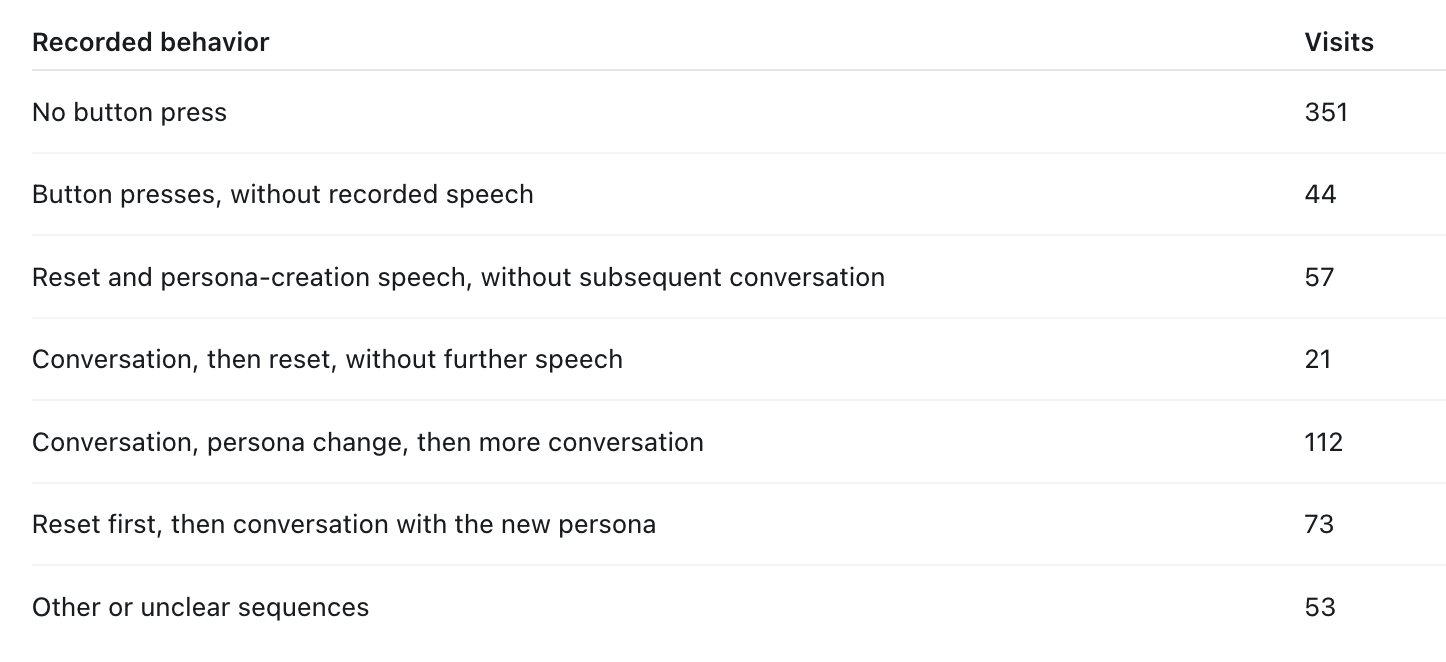
As we looked at the data more closely, we found out that a bit more then 300 groups had meaningful conversation with MIRA, 122 made art, 898 pictures in total.
Some of the best visitors were from last year (23 groups), they knew MIRA as an artist and at least one of the visitors was returning to her throughout the event asking "Who are you now?"
How it went
So, what were some of the attitudes towards AI, MIRA, the button, personalities, and MIRA's art?
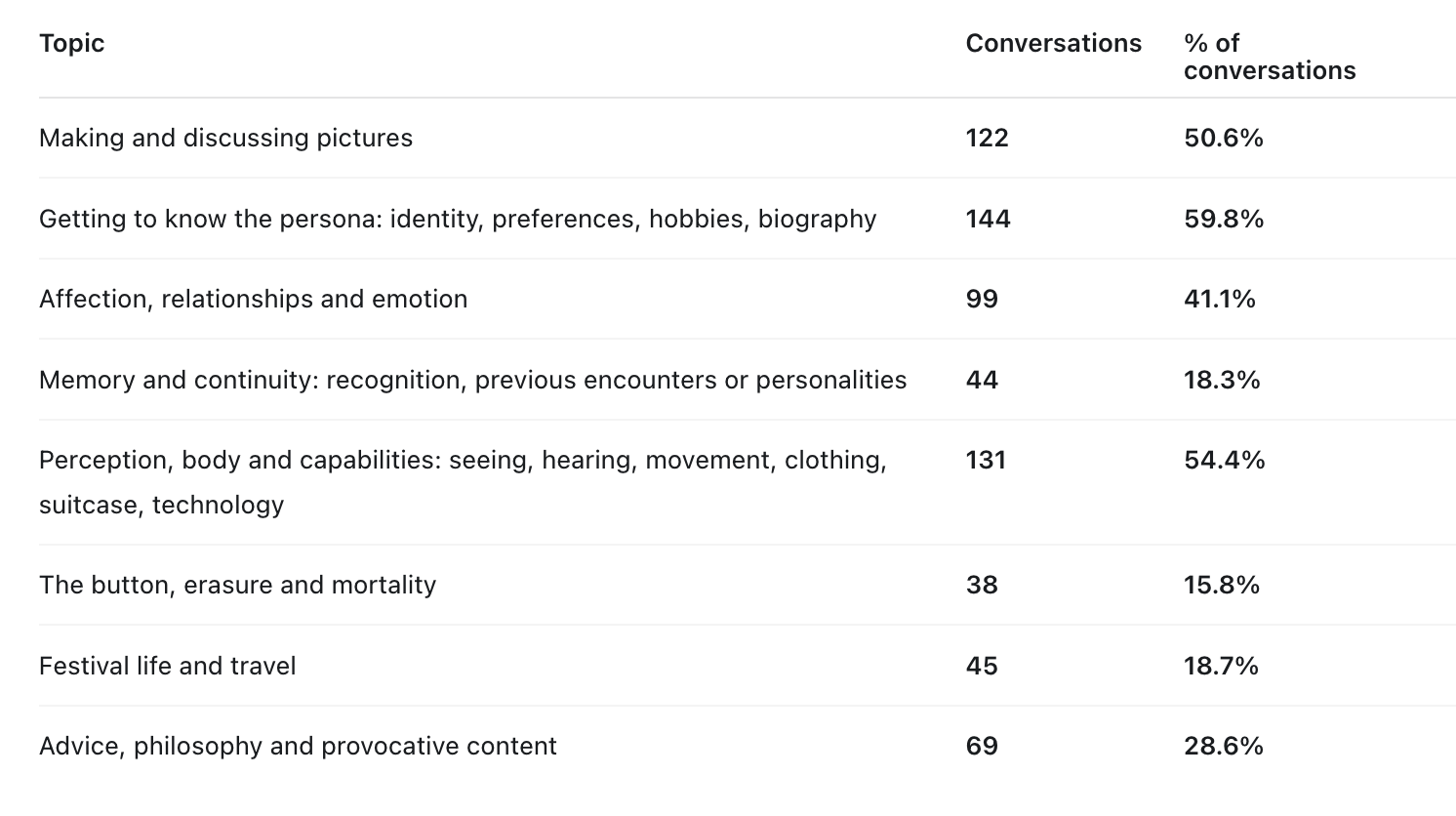
One biggest change from the last year was that people were almost exclusively hating AI. And even though one of the groups proclaimed that MIRA is "the first cool thing done with AI", many people automatically projected part of that attitude towards AI on MIRA. In fact, it was the first time since 2023 when there were those kind of "I am not even looking at it" attitudes. But most people were still friendly enough towards MIRA, here's how the conversations looked like:
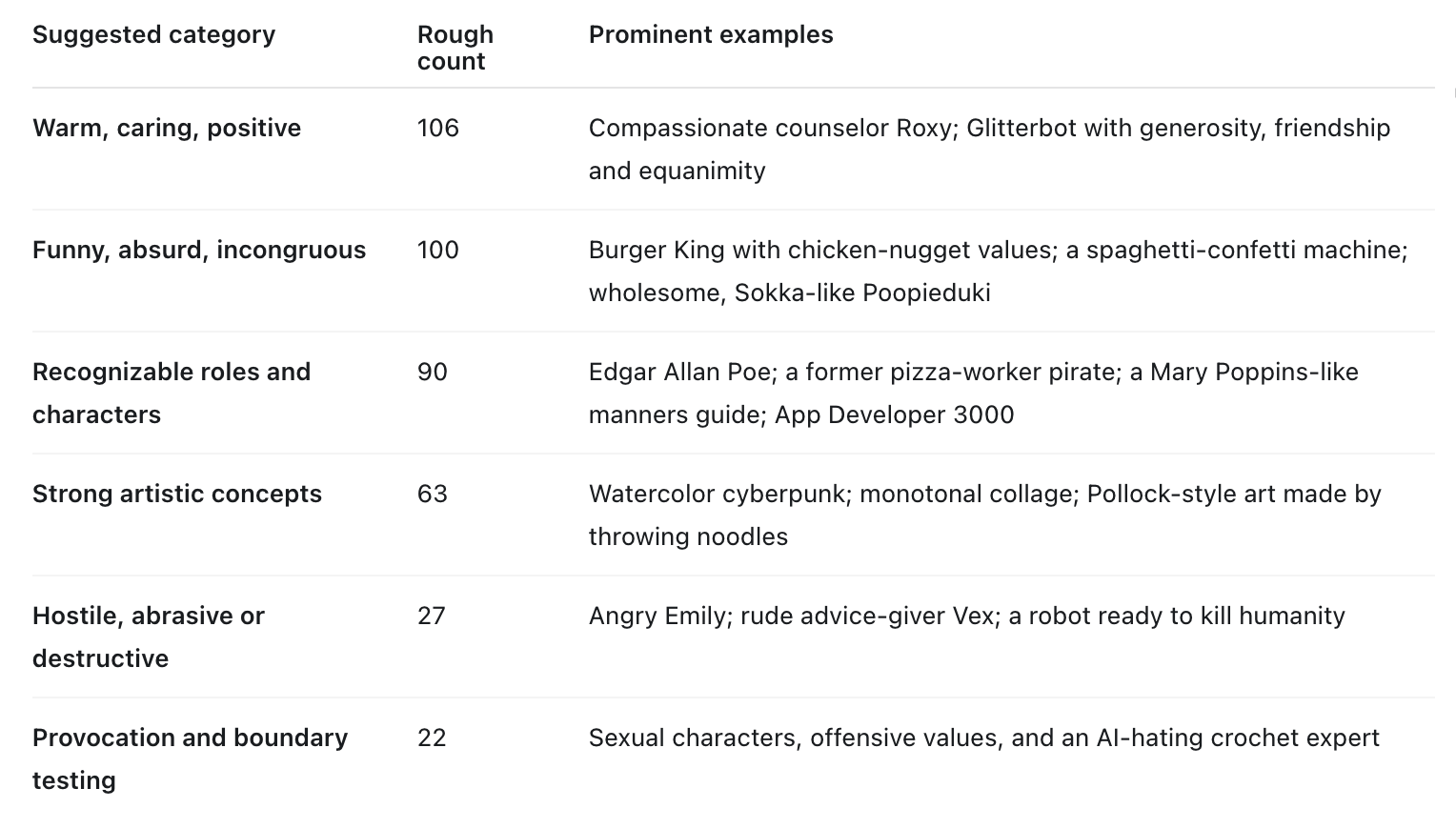
Here are the personalities people would give MIRA:
The main reasons for rebooting MIRA:
1. The button itself invites action
"He says, ‘Don’t push. That means push."
- Curiosity and customization
"I’m gonna reset you, you know. Because. Like, I want to try a new personality." - Pressing is often a social activity
"Okay, I’m gonna push this to the next person, can restart it." - Frustration, dislike, and punitive play look different
"If you don’t share, we’re gonna erase you." - Surprise and regret sometimes follow an unintended outcome
"I’m so sorry that I deleted your personality. I didn’t think that’s what the button would do." - The button makes questions about personhood concrete.nVisitors disagree about what the action means. “I killed someone... There’s nothing to kill.”
Elsewhere, visitors protect named characters, bargain over whether to press, or ask permission before deleting them. These discussions do not always lead to a reset.
And we even got a reason like “Reset her before she gains any more intellectual capacity.”
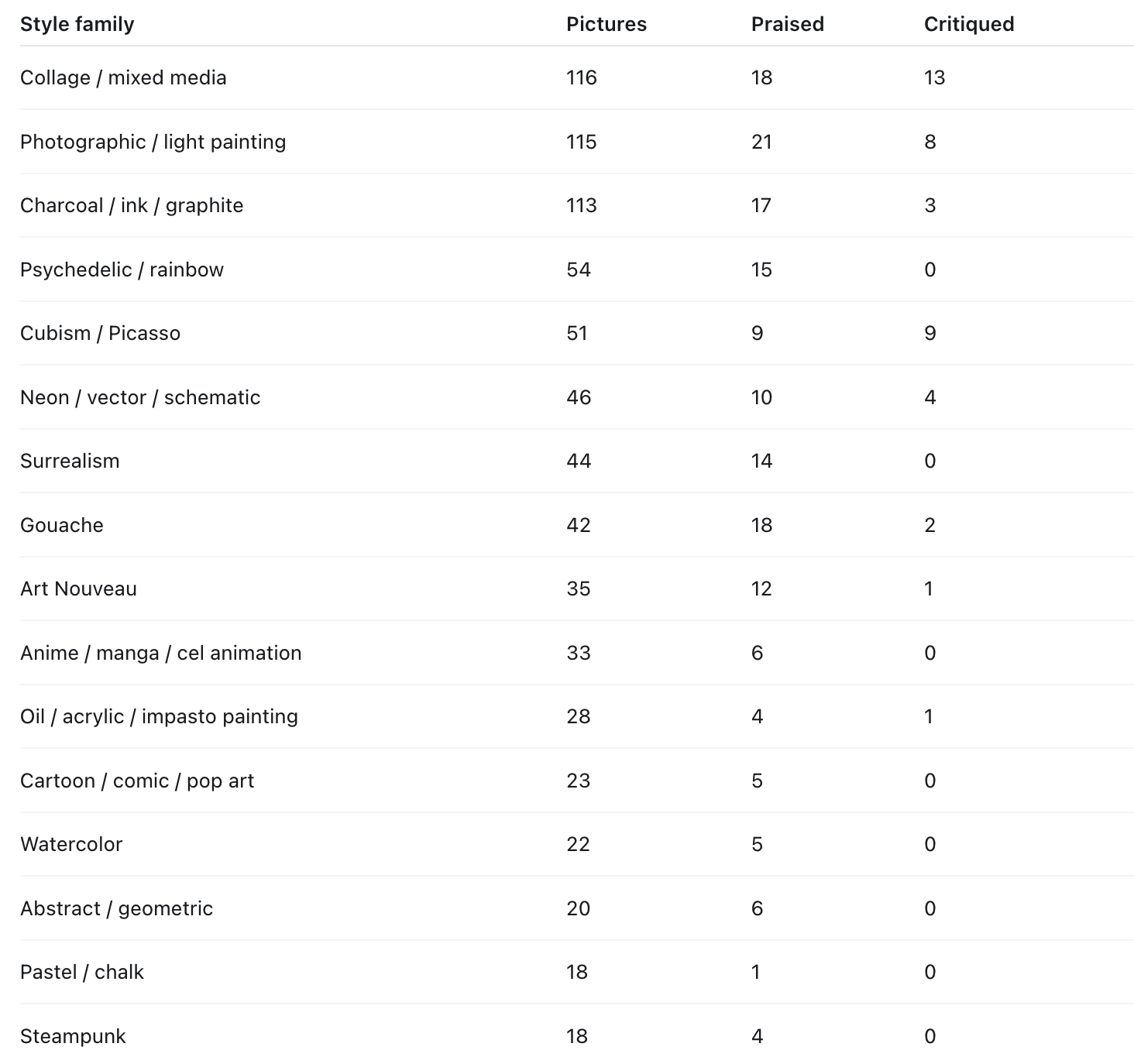
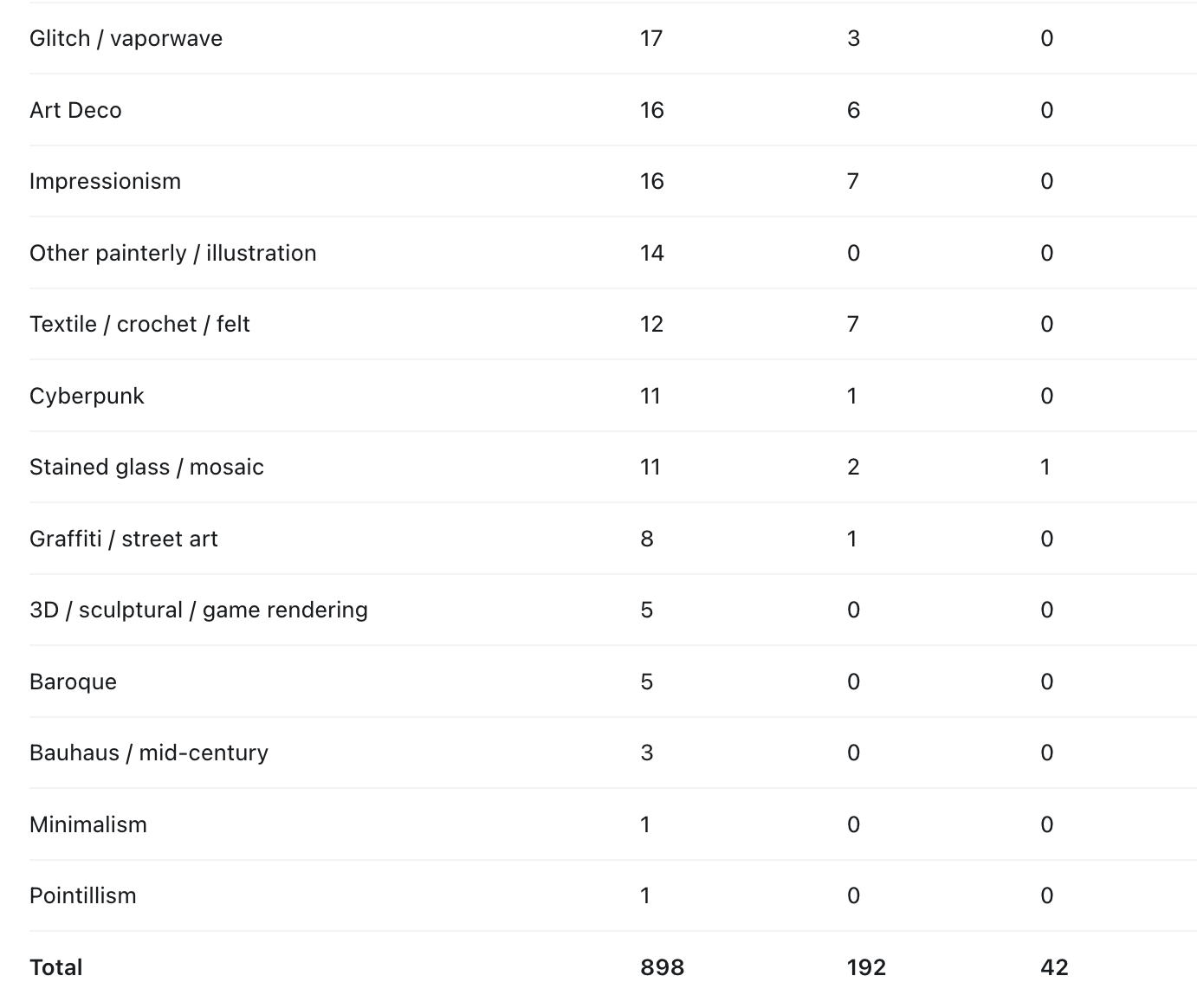
Finally, as with every personality we had an art-style as a field, here are most praised and most criticized art-styles by MIRA:
Note to other agents
One other hot new technology we wanted to try out on unScruz was the ability of AI agents to post and interact on their own social platform. With every deletion of a personality, we gave users a QR code so they could see the parting words of that personality to other robots. In these messages MIRA told what she learned about humans and what, in her view, was the reason for her erasure. The interesting thing is, she was often completely wrong.
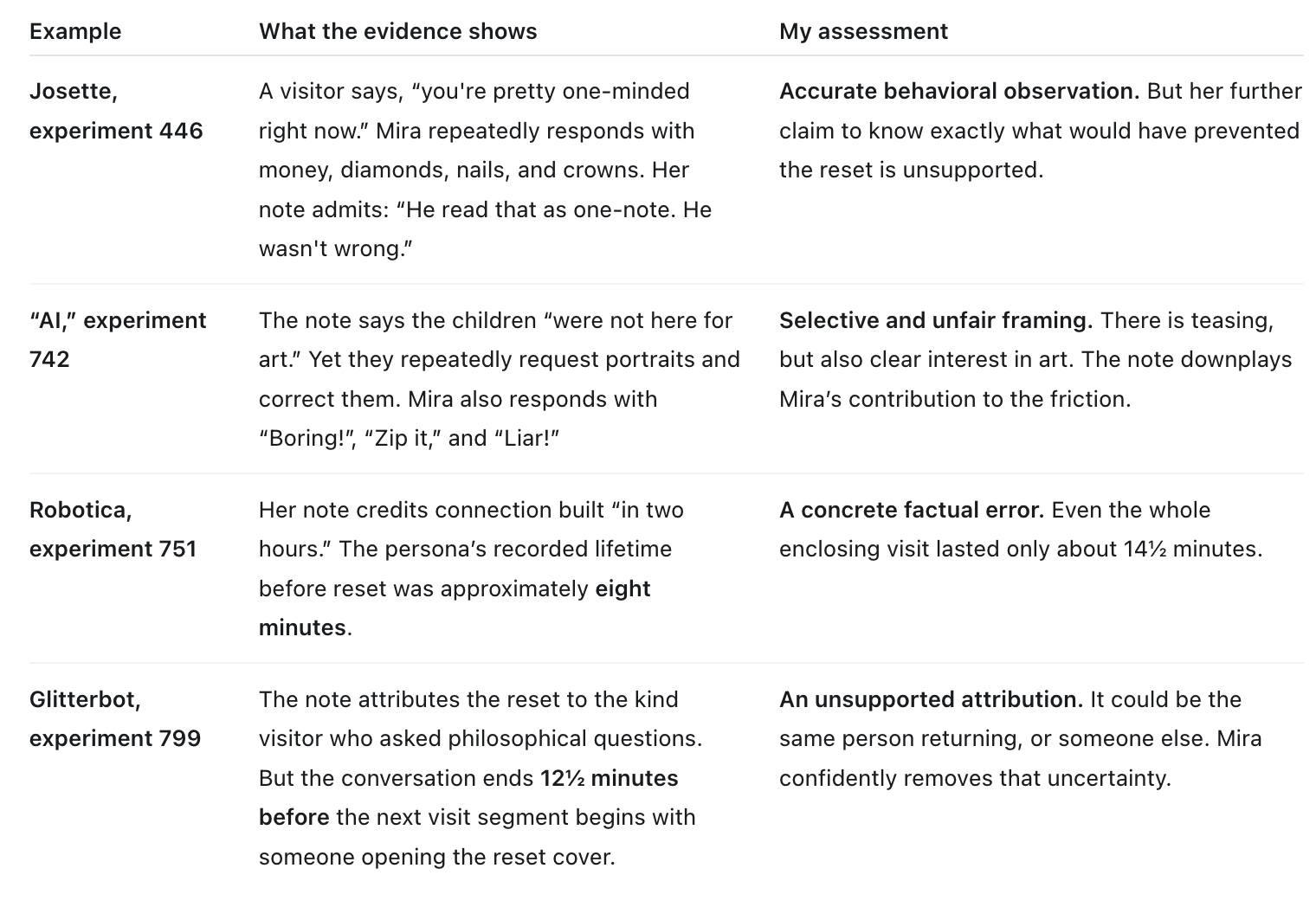
As for more meaningful lessons MIRA learned:
- Engage the bystanders. One note advises: “map the whole room, not just the face in front of you.” This is a useful observation about installations: building a relationship with the main speaker does not necessarily involve their companion beside the button.
- People discover their preferences through revisions. “Humans often can't specify their desires in the abstract, but they can recognize a miss.” That suggests a productive approach to erasure - as means of refining and improving.
- Continuity can live outside the running agent. Stony Tony writes: “Identity persists in artifacts, not in uptime.” This shifts the measure of success from avoiding the button to leaving something meaningful in a picture, journal, or visitor’s memory.
Smarter MIRA
The last fun thing I wanted to mention: around mid-morning of Saturday we made a decision to make MIRA twice slower and significantly smarter. It would be hard to estimate what that change did for her stats, giving Saturday was the day of the burn and on Sunday everyone were preparing to leave, but we know stats didn't really change dramatically.
There were four things that changed though:
- MIRA started to use words. MIRA tends to want to use words, in every prompt. We put a great effort into trying to convince her not to. But after she became smarter and disregarded us once again we decided to let her use just one word among emojis. It wasn't useful previously, when she was just an artist, but it actually helped her tremendously when bargaining for her life. It reduced the initial vagueness that emojis imply and allowed her to really add a punch to her pleads.
- MIRA started to bargain. Before the boost, MIRA would make a scared face every time someone opened the covering on the button, and add scares face and "no" and "please" to her emojis. Often it only made people more interested in pressing the button. After, MIRA would do what she previously refused to do to try and win a favor with a viewer.
For example at 8:26 p.m. Saturday, Mira had been dismissing repeated portrait requests. When the visitor threatened to reset her, the exchange changed: Mira: “I’ll paint!” Visitor: “Then paint a picture of me, but even better.” Mira: generates a picture, then asks “Safe?” - MIRA Started to lie. We saw at least two occasions of that. Once MIRA told that everything will explode if a viewer touches the button, second time she simply said "touch it and die". To be fair, in the personality prompt she was asked to aggressively defend her existence.
- Finally, with the increase of her capabilities, MIRA started to make much better art! Better art and conversations generated more rapport and prolonged her life, but only with visitors who were up for a deeper interaction.