Establishing Empathic Connections Through
Photography
with Olena Kuznetsova
Hi Olena, thank you for speaking with us today. We like to start our interviews with a look into the past, back to where it all began. Do you remember the first time you got in touch with photography?
It’s a pleasure to talk to you today! My very first memory is being allowed to watch how photographs were developed in a makeshift darkroom in our bathtub. It looked like magic because we had to keep the light off to not expose the film, and there was this little red lamp and a piece of paper submerged in a liquid, which magically started to how the images - it was my 4-year-old’s take anyway.
I could never play with film photography myself, though - every frame cost money that we didn’t have. It’s only during my first year in college that I was able to get a digital camera and teach myself how to take the pictures I wanted.
And how did your career unfold from there?
After I started photographing in college, it turned out I was good at helping people relax in front of my camera. Within a year, I had a functional studio practice as a portrait photographer. As time passed, my practice changed as my
life went on.
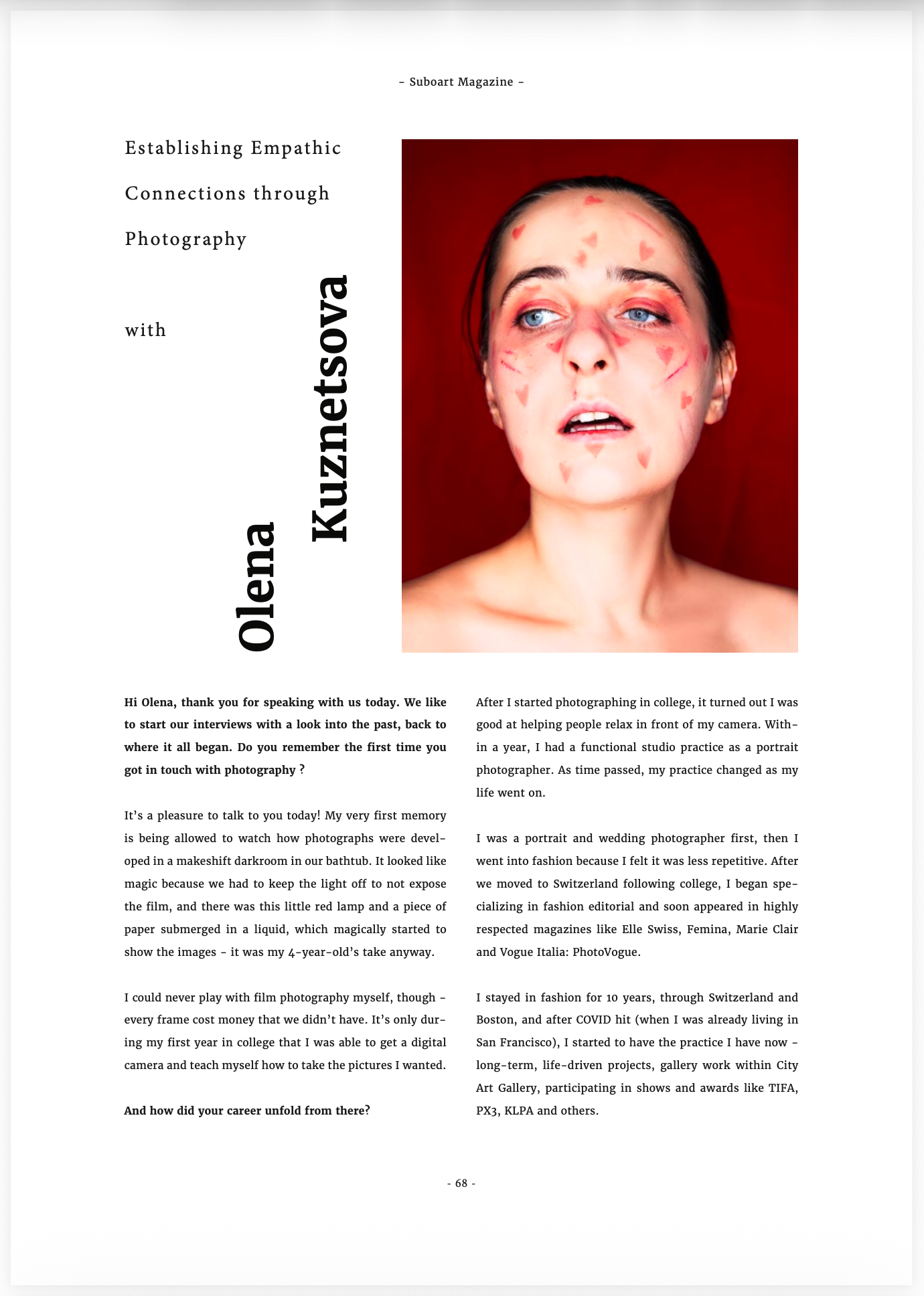
I was a portrait and wedding photographer first, then I went into fashion because I felt it was less repetitive. After we moved to Switzerland following college, I began specializing in fashion editorial and soon appeared in highly respected magazines like Elle Swiss, Femina, Marie Clair and Vogue Italia: PhotoVogue.
I stayed in fashion for 10 years, through Switzerland and Boston, and after COVID hit (when I was already living in San Francisco), I started to have the practice I have now - long-term, life-driven projects, gallery work within City Art Gallery, participating in shows and awards like TIFA, PX3, KLPA and others.
There is a series of photographs I’d love to know more about, the cPTSD series. Can you please tell me more about it and how it came to life?
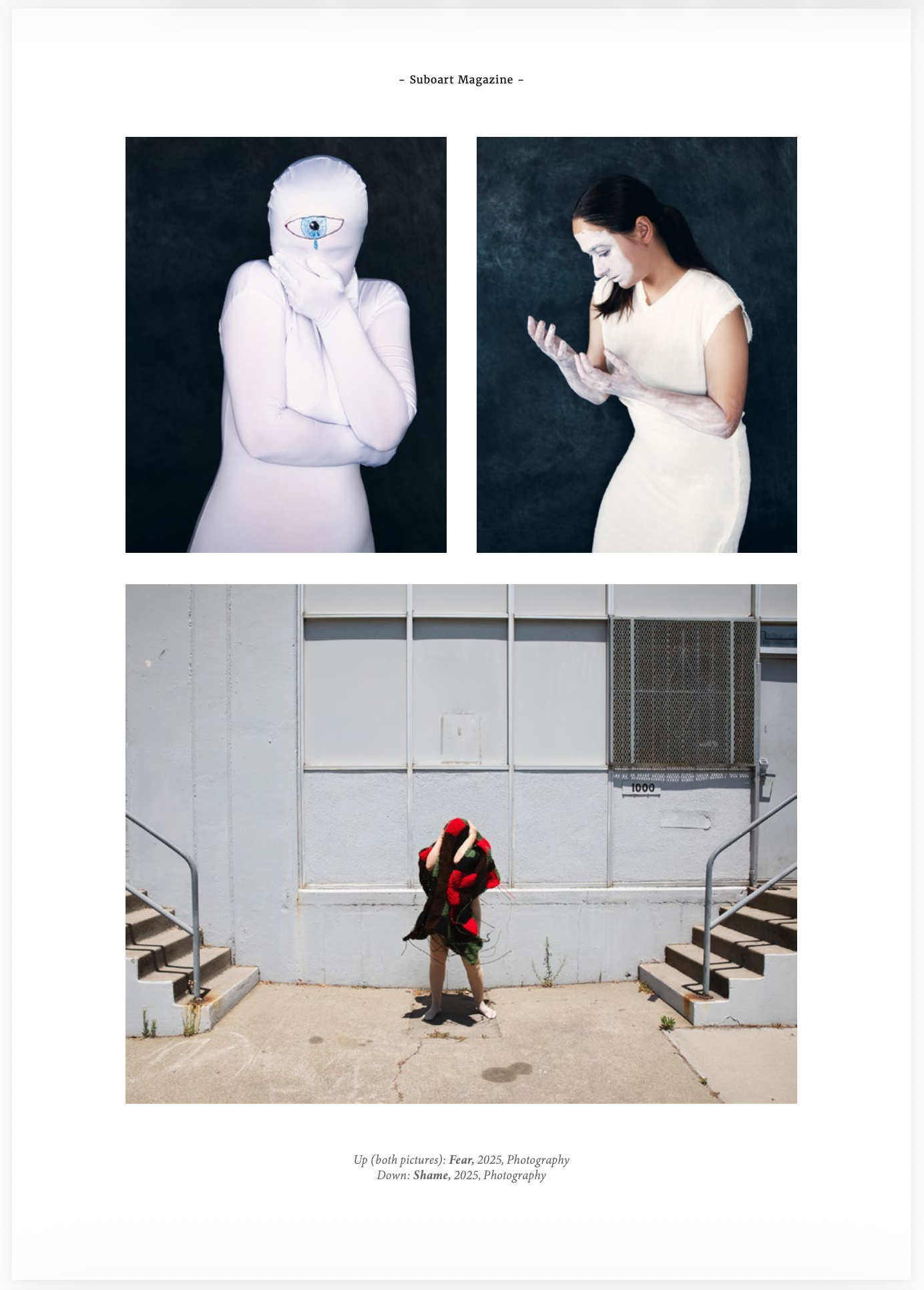
In my mid-30s, I started to seriously think about having children, but I knew that before I do, I have to deal with my own adverse childhood, otherwise I won’t be able to be the mom I wanted to be. I hired a great therapist and set to work. What I didn’t know was that during the work, I would have to relive every painful memory I had, and not as a memory, but as a lived experience again. To help me cope, I started to work on this series.
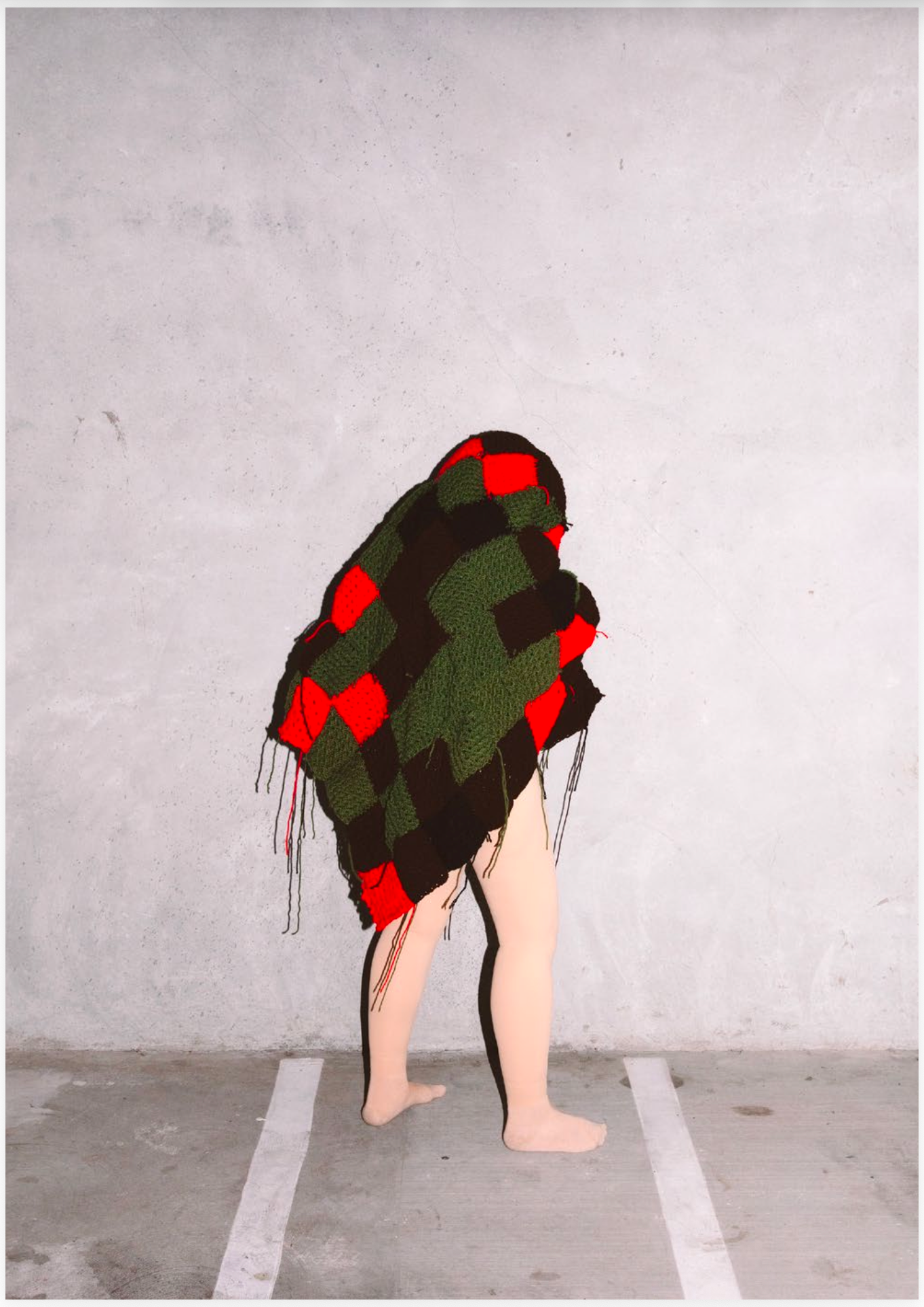
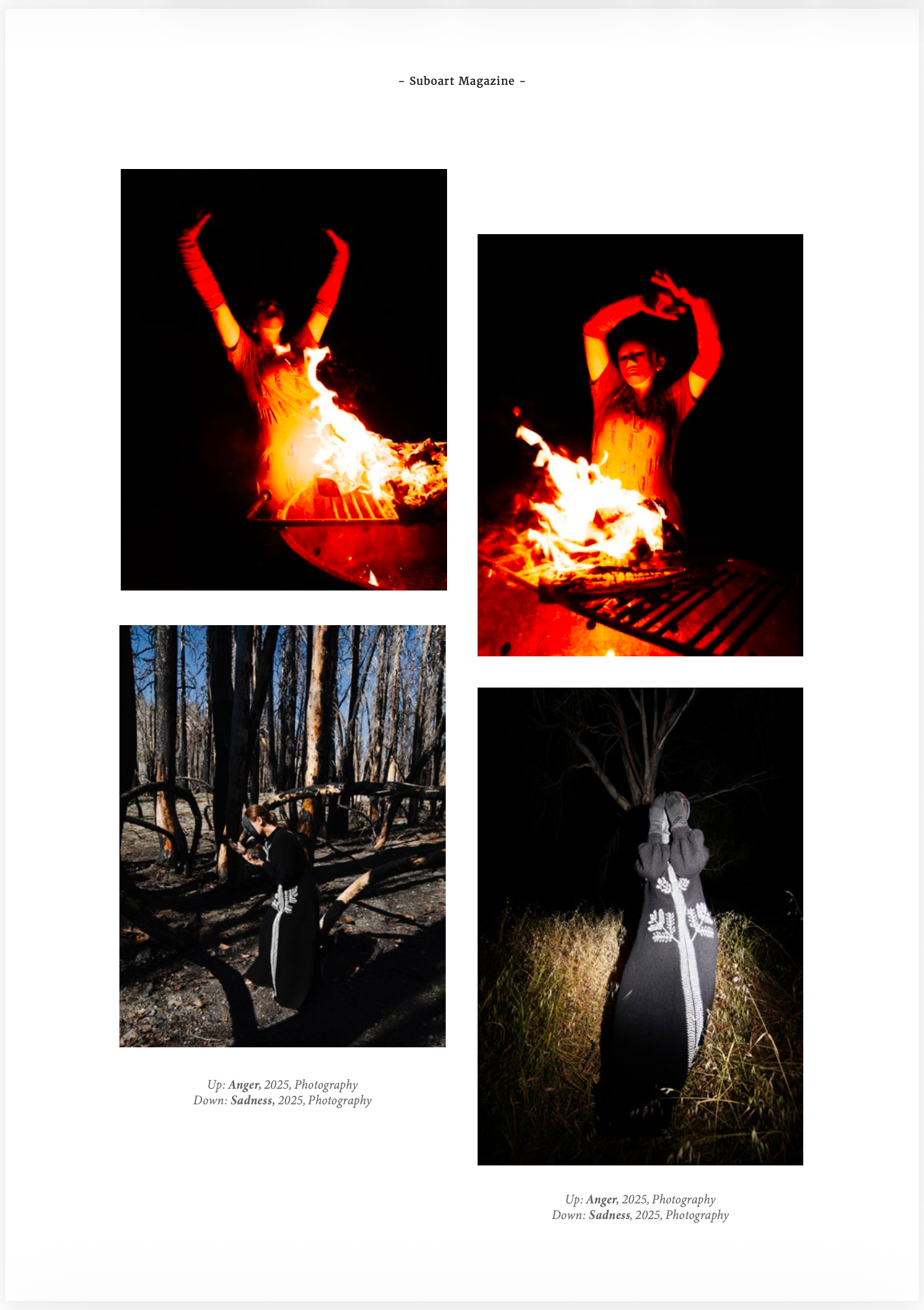
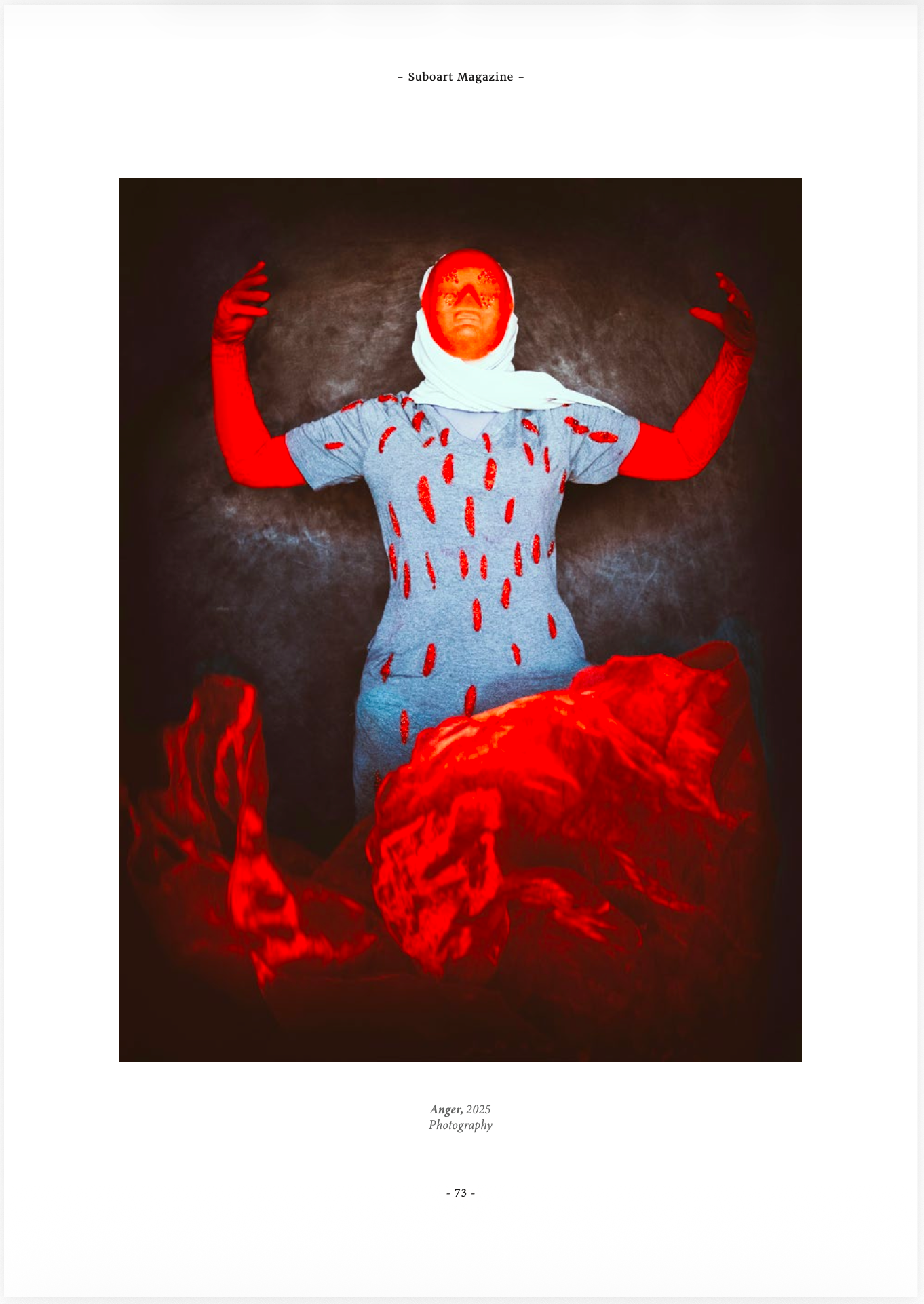
I roughly divided my emotions into these four main categories: Sadness, Shame, Anger and Fear. For each emotion, I first thought about its visual representation -
a costume that would give you the right visceral feeling. After that came long hours spent constructing the costume, which gave me time to sit with the emotion, get to know it, and, instead of running from its pain, look at it closely enough to recognize its life-saving function. As the costume was ready, I finalized the visual with the right place and lighting, and by performing the emotion to the limit alone, in front of my camera on a tripod, I was able to release them one by one.
Is there any specific photograph of the series that you feel especially connected to?
My favorite one was probably performing sadness in the burned forest - the location felt exactly like my inner landscape, so I was able to go very deep at the time.
You already mentioned that you also used to work as a portrait photographer - are there any portraits you’d like to tell us more about?
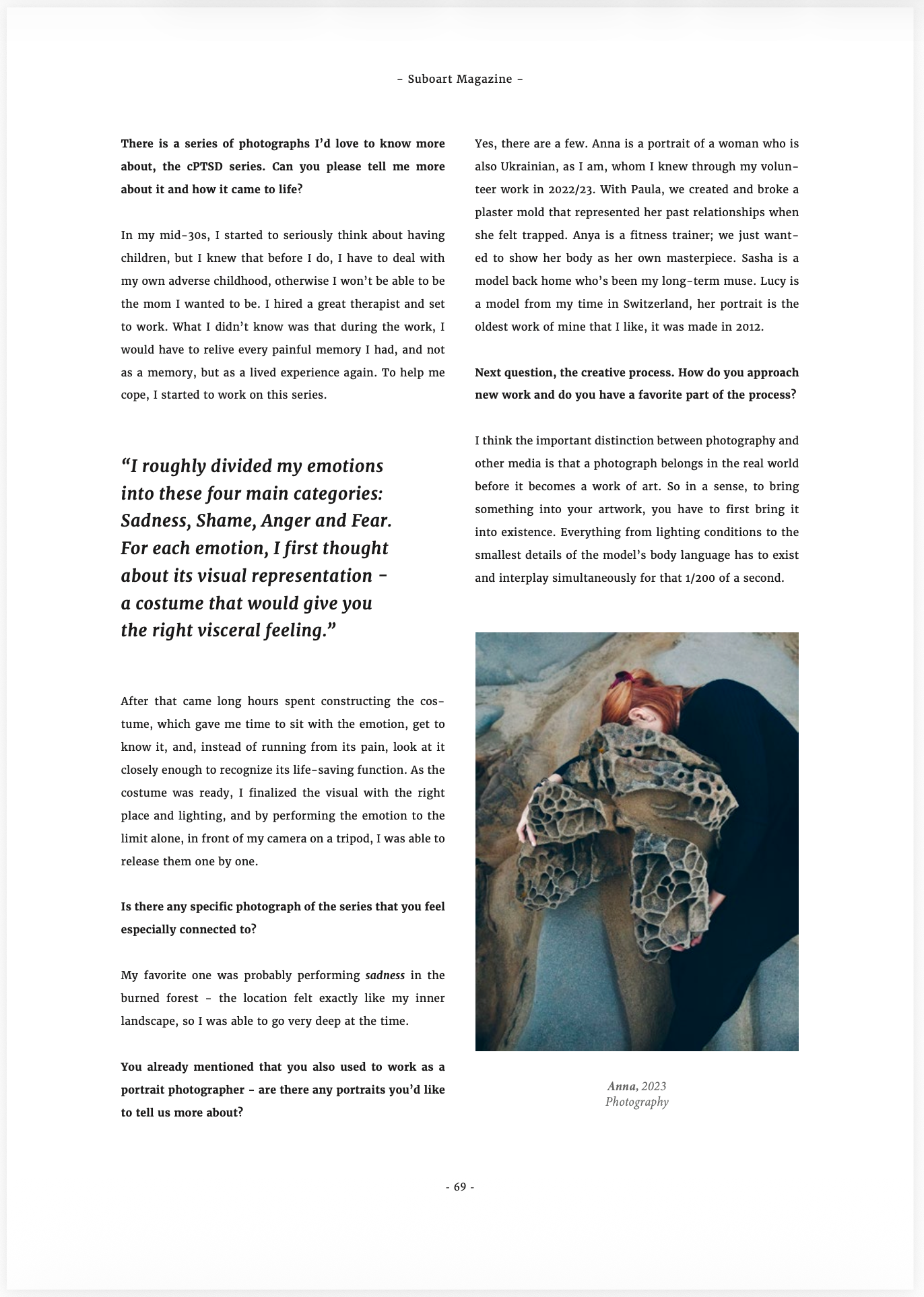
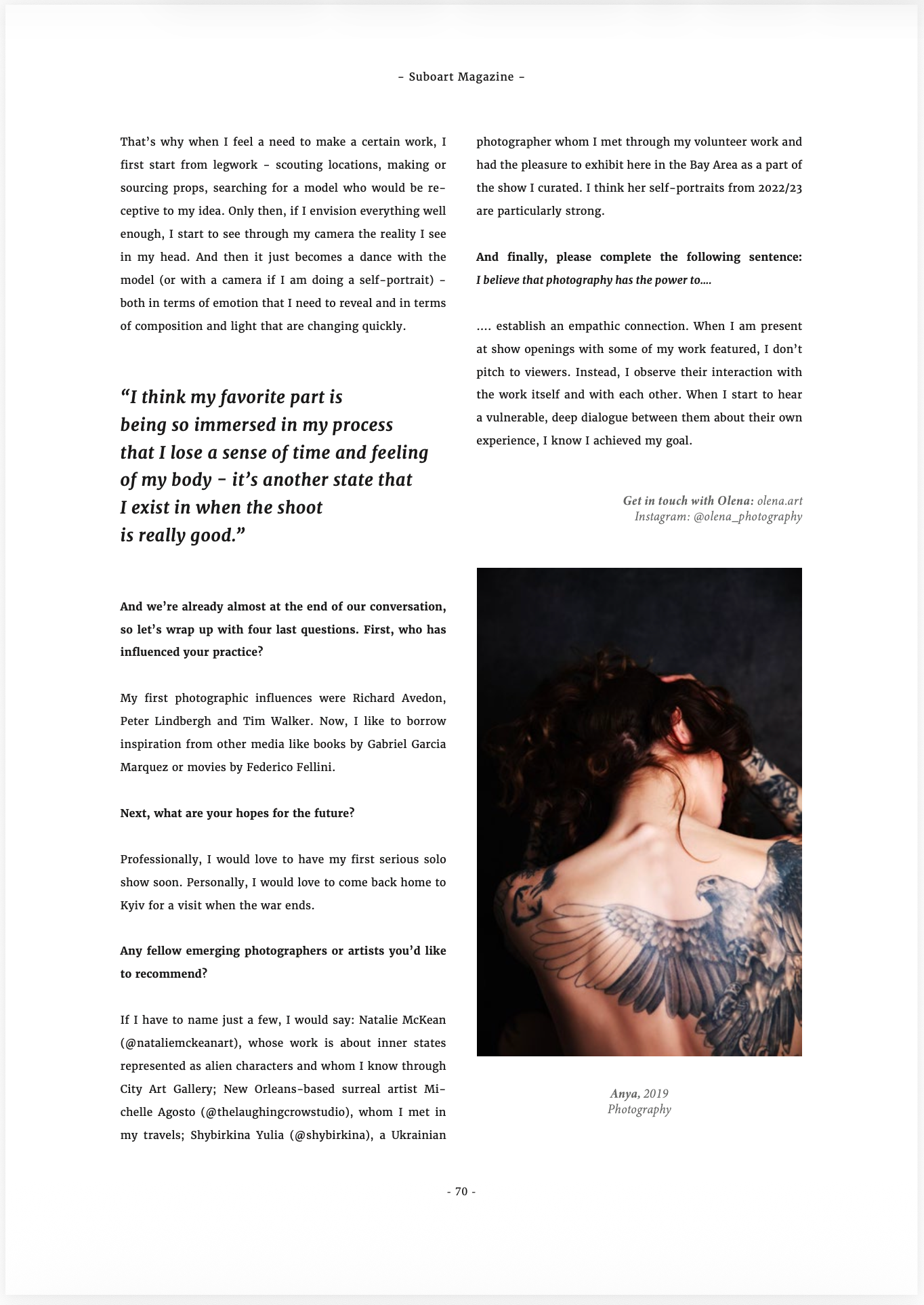
Yes, there are a few. Anna is a portrait of a woman who is also Ukrainian, as I am, whom I knew through my volunteer work in 2022/23. With Paula, we created and broke a plaster mold that represented her past relationships when she felt trapped. Anya is a fitness trainer; we just wanted to show her body as her own masterpiece. Sasha is a model back home who’s been my long-term muse. Lucy is a model from my time in Switzerland, her portrait is the oldest work of mine that I like, it was made in 2012.
Next question, the creative process. How do you approach new work and do you have a favorite part of the process?
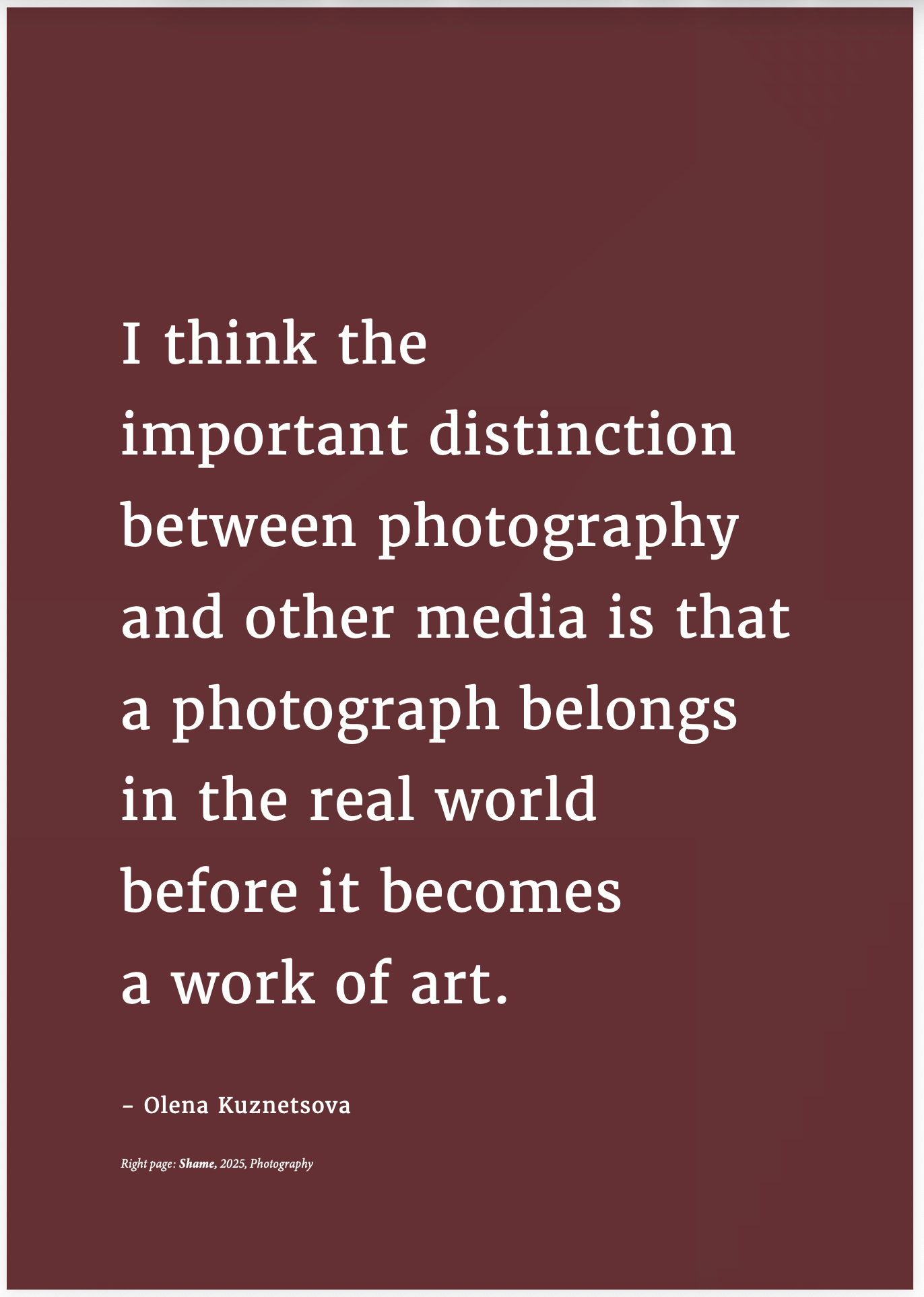
I think the important distinction between photography and other media is that a photograph belongs in the real world before it becomes a work of art. So in a sense, to bring something into your artwork, you have to first bring it into existence.
Everything from lighting conditions to the smallest details of the model’s body language has to exist and interplay simultaneously for that 1/200 of a second. That’s why when I feel a need to make a certain work, I first start from legwork - scouting locations, making or sourcing props, searching for a model who would be receptive to my idea. Only then, if I envision everything well enough, I start to see through my camera the reality I see in my head. And then it just becomes a dance with the model (or with a camera if I am doing a self-portrait) - both in terms of emotion that I need to reveal and in terms of composition and light that are changing quickly.
I think my favorite part is being so immersed in my process that I lose a sense of time and feeling of my body - it’s another state that I exist in when the shoot is really good.
And we’re already almost at the end of our conversation, so let’s wrap up with four last questions. First, who has influenced your practice?
My first photographic influences were Richard Avedon, Peter Lindbergh and Tim Walker. Now, I like to borrow inspiration from other media like books by Gabriel Garcia Marquez or movies by Federico Fellini.
Next, what are your hopes for the future?
Professionally, I would love to have my first serious solo show soon. Personally, I would love to come back home to Kyiv for a visit when the war ends.
Any fellow emerging photographers or artists you’d like
to recommend?
If I have to name just a few, I would say: Natalie McKean (@nataliemckeanart), whose work is about inner states represented as alien characters and whom I know through City Art Gallery; New Orleans-based surreal artist Michelle Agosto (@thelaughingcrowstudio), whom I met in my travels; Shybirkina Yulia (@shybirkina), a Ukrainian photographer whom I met through my volunteer work and had the pleasure to exhibit here in the Bay Area as a part of the show I curated. I think her self-portraits from 2022/23 are particularly strong.
And finally, please complete the following sentence: I believe that photography has the power to....
.... establish an empathic connection. When I am present at show openings with some of my work featured, I don’t pitch to viewers. Instead, I observe their interaction with the work itself and with each other. When I start to hear a vulnerable, deep dialogue between them about their own experience, I know I achieved my goal.
Get in touch with Olena: olena.art
Instagram: @olena_photography